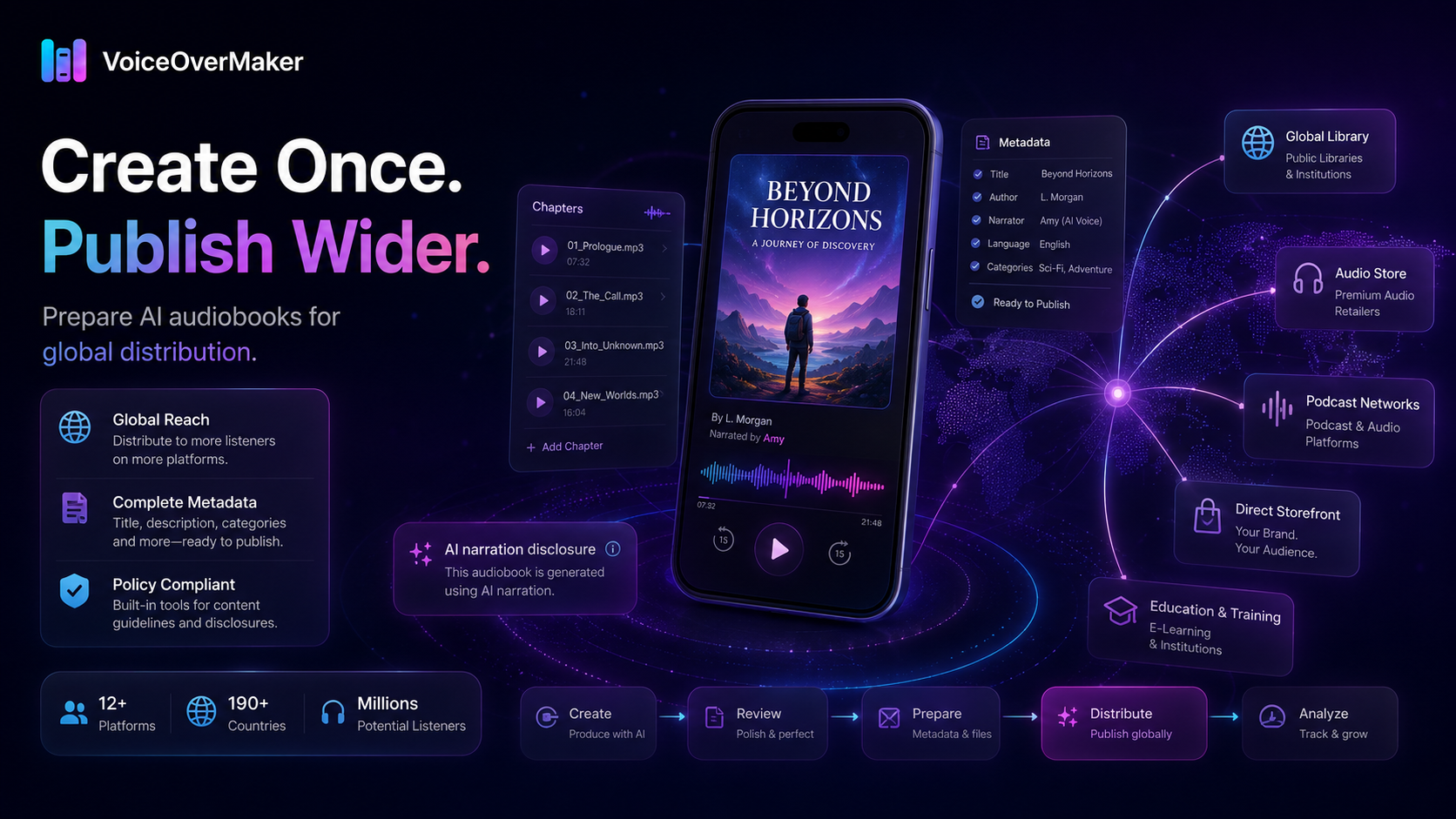
You have finished the manuscript. You have generated the narration. The voices sound good. The chapters are reviewed. Now comes the question many creators discover too late: Where can an AI-narrated audiobook actually be published?
The answer is not simply "everywhere." Retailers have different policies, and those policies change.
As of this article's August 2026 research, PublishDrive's current AI-content guidance lists several audiobook stores as accepting AI narration, usually with disclosure requirements, while Audible does not accept externally AI-narrated books and instead only accepts AI narration produced through Audible's own narration tool. Always verify the current rule before upload.
Current AI-Narration Acceptance Through PublishDrive
The following table summarizes which major audiobook stores accept AI-narrated titles based on PublishDrive's current distribution guidance:
| Store | AI Narration Accepted? | Disclosure Requirement |
|---|---|---|
| Apple Books | Yes | Narrating tool and voice should be included in metadata |
| Google Play | Yes | Narrating tool and voice should be included in metadata |
| Kobo | Yes | Follow Kobo AI-content requirements |
| OverDrive | Yes | AI narration should be clearly disclosed in metadata/description |
| Spotify | Yes | Narrating tool and voice should be declared in metadata |
| Storytel | Yes | Narrating tool and voice should be declared in metadata |
| Bookmate | Yes | Narrating tool and voice should be declared in metadata |
| Audible | Restricted | Only AI narration made with Audible's own narration tool is accepted |
Important: This table is a snapshot, not a permanent promise. Check the distributor and retailer immediately before submitting a title.
Why Disclosure Matters
Store policy can require it. PublishDrive's metadata guidance says AI narration should be indicated in the narrator field and/or book description according to store requirements. Transparency is part of distribution preparation, not an optional marketing decision. A book rejected for incorrect metadata is not helped by excellent audio.
Think of disclosure the same way you think of any other metadata field: it is required information that enables distribution. Skipping it creates friction. Including it removes a barrier.
Prepare the Audio Before Thinking About Stores
Distribution starts with production quality. No store policy will save a poorly produced audiobook. Before submitting anywhere, ensure your audio meets these baseline requirements:
- Appropriate MP3 files — correct bitrate and sample rate for the target platform
- Clean audio — no artifacts, distortion, or encoding errors
- Correct chapter order — files named and sequenced logically
- Proper chapter structure — each file represents one logical chapter
- Appropriate volume — consistent levels across all chapters
- No clicks and pops — clean transitions between sections
- No excessive background noise — silence should be silent
- No long unintended silence — gaps should be deliberate, not errors
If you are using VoiceOverMaker to produce your audiobook, the export workflow handles most technical formatting. But always listen to the final files before submission.
Use One File Per Logical Chapter
A clear chapter structure benefits both production and distribution. Most stores expect one audio file per chapter. This also makes quality control easier — you can review, re-generate, and replace individual chapters without touching the rest of the book.
Name files consistently. A pattern like 01-chapter-one.mp3, 02-chapter-two.mp3 removes ambiguity during upload. Some distributors will reject submissions where file ordering is unclear.
Your Cover Matters Too
Audiobook storefronts are visual marketplaces. Listeners browse covers the same way readers browse book covers in a shop. Your cover should remain readable at thumbnail size.
Avoid these common cover mistakes:
- Tiny subtitles — if text is unreadable at 200px wide, remove it
- Too many characters — simplify the composition
- Low-contrast typography — title must pop against the background
- Screenshots used as cover art — this looks unprofessional on any storefront
- Cluttered layouts — clean designs perform better at small sizes
Metadata Is Part of SEO
Book-store search depends on clear information. When listeners search for audiobooks, the metadata you provide determines whether your title appears. Prepare these fields before submission:
- Title — exact, final title
- Subtitle — optional but valuable for discoverability
- Author — as it appears on the cover
- Narrator — include AI narration tool name per store requirements
- AI narration disclosure — as required by each retailer
- Description — compelling, keyword-rich book summary
- Category — correct genre classification
- Language — primary language of the audiobook
- Keywords — relevant search terms listeners would use
- Price — competitive within your genre
- Publication date — release date for the audiobook edition
Missing metadata means missed discovery. A well-produced audiobook with incomplete metadata will underperform a mediocre audiobook with complete metadata in store search results.
Direct Publishing vs a Distributor
Two approaches exist for getting your audiobook into stores:
Direct publishing (store by store):
- Full control over each store's listing
- Direct relationship with the platform
- Managing multiple dashboards, formats, and reporting systems
- Different upload requirements per store
Using a distributor (like PublishDrive):
- Centralized distribution to multiple stores from one dashboard
- Consolidated reporting and royalty tracking
- Distributor handles format conversion where needed
- Single upload, multiple storefronts
A distributor does not override each retailer's rules. If a store requires specific metadata or rejects AI narration, the distributor passes that requirement through. The convenience is operational, not regulatory.
What About Earnings?
Do not create a financial forecast based on one generic figure. Audiobook earnings vary enormously based on multiple factors. Before setting expectations, check:
- Store royalty terms — different stores offer different percentages
- Distributor fees — percentage or flat fee per transaction
- Subscription plan — some stores pay per listen in subscription models
- Territory pricing — prices vary by country
- Library models — OverDrive pays differently than retail stores
- Promotional discounts — may reduce per-unit revenue
- Taxes — withholding varies by jurisdiction
- Refunds — some platforms allow listener returns
- Currency conversion — international sales involve exchange rates
The most useful financial planning comes from publishing one title, observing actual performance across stores, and using that data to inform decisions about your next title.
A VoiceOverMaker to Distribution Workflow
Here is a practical workflow from manuscript to published audiobook, using VoiceOverMaker for production and a distributor for reach:
- Write or import your manuscript — clean text, ready for narration
- Build your project in VoiceOverMaker — organize into chapters
- Cast your narrator and characters — assign distinct voices to each role
- Configure pacing and direction — set emotional tone per section
- Generate and review every chapter — listen critically, re-generate where needed
- Export final audio — one file per chapter, correct format
- Validate distributor requirements — check file specs, duration, quality
- Create cover and metadata — all fields complete
- Declare AI narration — follow each store's disclosure format
- Submit to compatible stores — via direct upload or distributor
- Monitor acceptance and feedback — track approval status per store
Each step feeds the next. Skipping the review step or the metadata step creates problems downstream that are harder to fix than they were to prevent.
What Should You Do About Audible?
At the time of writing, Audible does not accept externally AI-narrated audiobooks. Their platform only accepts AI narration produced through Audible's own narration tool.
Do not attempt to disguise AI narration as human narration. This approach will result in rejection, potential account issues, and wasted time. Instead:
- Use the channels that accept your production method
- Follow disclosure rules on every platform
- Build your catalog on compatible stores
- Revisit Audible's policy if and when it changes
The audiobook market is not Audible-only. Apple Books, Spotify, Google Play, Kobo, Storytel, and library systems represent substantial audiences. A well-distributed AI-narrated audiobook can reach millions of listeners without Audible.
What About Apple Books?
PublishDrive's current guidance says Apple Books accepts AI-narrated audiobooks with narration information included in metadata. Apple has one of the largest audiobook audiences globally, making it a strong channel for AI-narrated titles.
For creators building bedtime story collections or multilingual audiobooks, Apple Books' international reach is particularly valuable. The same title can serve listeners across dozens of countries.
Why This Is a Strong Opportunity for Indie Creators
The opportunity is not "AI lets you upload infinite books." That approach produces noise, not income.
The real opportunity is: audio production is becoming accessible to creators who can build a focused, well-edited catalog. The cost barrier that once prevented independent authors from producing audiobooks has dropped significantly. What remains is the craft — choosing the right material, producing it well, marketing it effectively.
A thoughtful 10-title catalog is more defensible than 1,000 low-effort uploads. Each title benefits from the quality and reputation built by the others. Stores reward consistent quality with visibility. Listeners who enjoy one title come back for more.
The creators who will benefit most from AI narration distribution are those who treat it as publishing — with all the care, metadata, and audience awareness that implies — rather than as content generation.