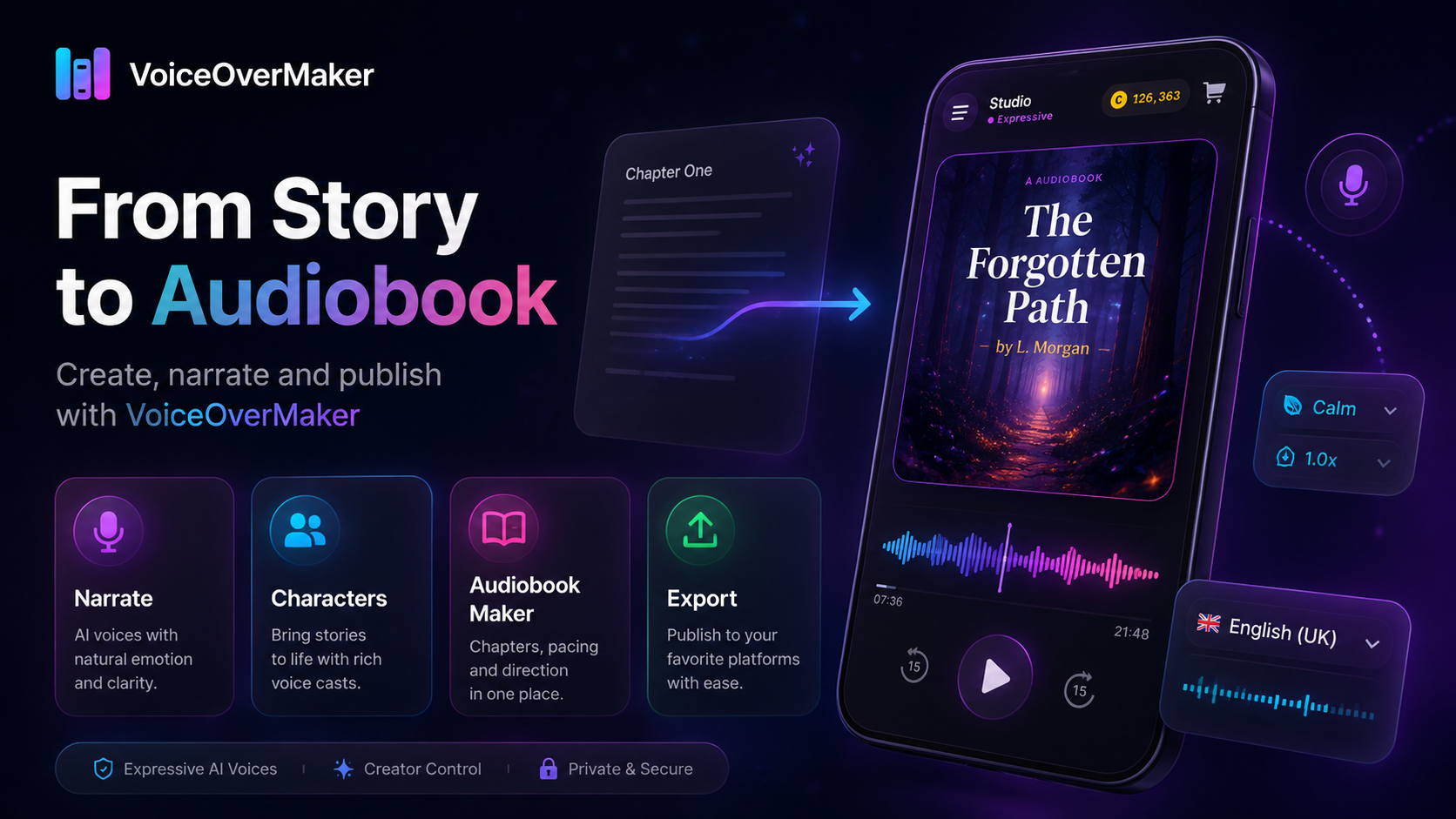
A story can now become more than a document. An original manuscript can become an ebook, an audiobook, a collection of short narrated episodes, a bedtime-story series, educational audio, or promotional content for social platforms.
For independent creators, this creates an interesting opportunity: produce one piece of original intellectual property and package it in several formats for different audiences.
AI narration can reduce some of the production work involved in experimenting with audio. It does not guarantee sales, and it does not remove the need for good writing, editing, rights management, quality control, cover design, metadata, marketing, or compliance with retailer policies.
But it can make audiobook creation more accessible to writers who previously thought professional audio production was outside their reach.
The Basic Creator Business Model
The simplest model looks like this:
Original idea → Written story → Narrated audiobook → Cover + metadata → Distribution → Discovery → Potential salesThe important word is original. If you want to sell or distribute a story, you should own the necessary rights to the text, artwork, audio and other assets you use.
1. Start With a Focused Audio Product
You do not need to begin with a 70,000-word novel. A first audio project could be:
- A short mystery
- A collection of bedtime stories
- A children's adventure
- A motivational mini-book
- Language-learning stories
- Guided educational content
- A short business guide
- Episodic fiction
- A collection of original fairy tales
- A niche nonfiction handbook
Shorter projects can be useful for testing your workflow before committing to a full-length audiobook. Think of your first project as a product experiment, not merely an audio conversion.
2. Write for Listening, Not Only Reading
A sentence that looks excellent on a page can sound awkward when spoken aloud. Before generating audio, edit your manuscript for the ear.
Look for:
- Sentences that are too long
- Repeated words
- Difficult names
- Abbreviations
- URLs
- Footnotes that do not work in speech
- Dialogue where the speaker is unclear
- Paragraphs that need pauses
- Dramatic moments that need slower delivery
3. Build the Audiobook in Scenes
Instead of treating the entire manuscript as one giant text-to-speech request, break it into manageable sections. A structured approach gives you more control.
In VoiceOverMaker, creators can use audiobook and storytelling workflows alongside voice selection, pacing, additional direction and delivery styles. That makes it possible to treat narration more like a production than a single "convert text" operation.
4. Cast the Narrator and Characters
Multi-character audio can create a more theatrical listening experience. You might use one narrator, one voice for the protagonist, another for a recurring friend, another for an antagonist, and separate voices for special characters. Learn more about casting different AI character voices for your audiobook.
The goal is clarity and character consistency. Test voices using real dialogue from your story rather than only a generic demo sentence.
5. Direct the Performance
Voice selection is only one layer. The same sentence can feel completely different depending on its delivery.
VoiceOverMaker's current expressive workflows include tools for pacing, direction and delivery styles such as calm, whisper, excited, serious, curious and dramatic. Use those tools to shape the scene rather than changing actors every time the emotion changes.
6. Review Every Chapter
AI generation should not eliminate editorial review. Listen for:
- Incorrect pronunciation
- Unnatural pauses
- Inconsistent character voices
- Dialogue spoken by the wrong actor
- Missing lines
- Unusual emphasis
- Clipping or distortion
- Excessive silence
- Obvious generation artifacts
For commercial publishing, quality control matters.
7. Package the Audiobook Like a Product
An audiobook needs discoverability. Prepare:
- Title and subtitle
- Author name
- Narrator information
- Description
- Category
- Search keywords
- Professional square cover
- Chapter files
- Sample audio
- Pricing
- Publication date
Metadata is not a minor administrative task. It helps stores understand what your book is and helps potential listeners decide whether it is for them.
8. Choose Where You Want to Sell
Creators can distribute directly through individual retailers or use a distributor. PublishDrive, for example, positions itself as a global self-publishing platform for ebooks, print books and audiobooks.
AI-narrated audiobook policies differ by retailer, and disclosure requirements matter.
9. Build More Than One Revenue Path
An audiobook does not have to live in only one place. Depending on your content rights and platform terms, a creator might explore:
- Retail audiobook sales
- Library distribution
- Ebook + audiobook catalog
- Direct bundles
- Episodic content
- Discovery content on social media
- Licensing opportunities
For creators with multilingual content, global reach opens additional distribution channels across different language markets.
10. Think in Catalogs, Not One-Off Uploads
One title can succeed, but a catalog creates more opportunities to be discovered. A consistent series can reuse branding, narrator, character voices, cover style, audience, keywords, and marketing channels. That is a more sustainable publishing mindset than repeatedly starting from zero.
A Practical First Project
Do not begin by trying to build an audiobook empire. Try this:
- Week 1: Write one original 2,000–5,000 word story
- Week 2: Create and review the narration
- Week 3: Create a professional cover and metadata
- Week 4: Research compatible distribution channels and publish where appropriate
- After launch: Study listener feedback and improve the next title