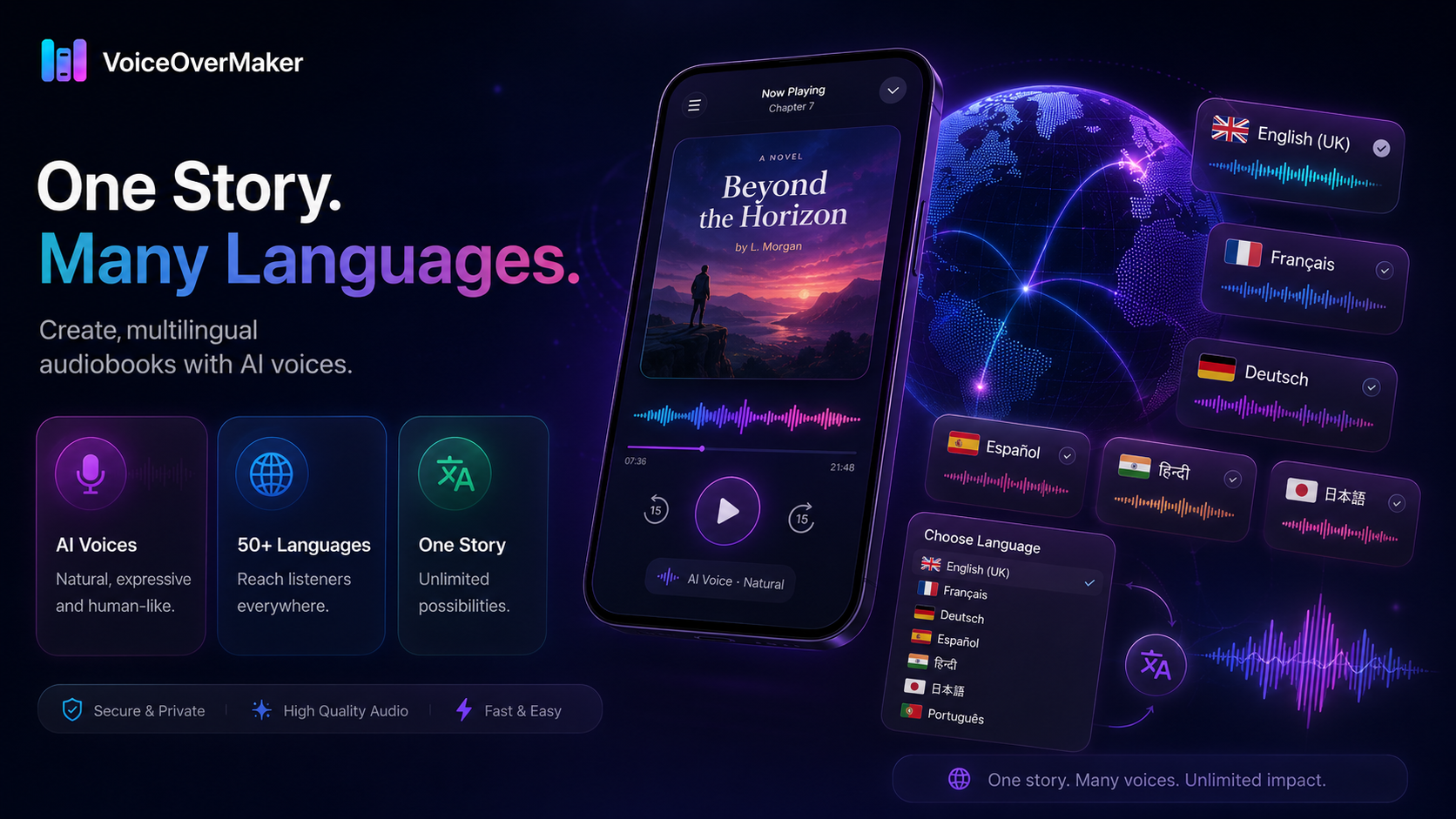
A story does not have to stop at one language. For an independent author, one successful manuscript can potentially become several localized editions.
But creating a multilingual audiobook is not as simple as translating every sentence and pressing Generate. Translation and localization are different jobs. The strongest international audio respects language, culture, dialogue, pronunciation and performance.
Step 1: Choose the Right Story to Localize
Do not translate an entire catalog merely because the technology can. Start with a title that has:
- Clear audience
- Strong listener feedback
- Evergreen subject matter
- Internationally understandable themes
- Rights that allow translation and localization
A proven story is a better localization candidate than an untested draft.
Step 2: Translate Meaning, Not Word Order
Literal translation can produce awkward narration. A good localized manuscript asks: "How would a natural speaker express this idea?"
For commercial work, professional linguistic review is especially valuable. AI can assist the workflow, but the final text should be reviewed by someone capable of judging the target language accurately.
If you are thinking about the revenue side of multilingual audiobook production, see our guide on how to make money with AI audiobooks for a broader business model overview.
Step 3: Localize Names, Measurements and References
Not everything needs to be changed. But review these elements carefully:
- Units — metric versus imperial, temperature scales
- Date formats — day/month/year versus month/day/year
- Currency references — dollars, euros, pounds, or local equivalent
- Jokes and idioms — humor that depends on word play or cultural context
- School terminology — grade levels, qualifications, systems
- Cultural references — holidays, foods, media, sports
- Formal vs informal address — tu/vous, du/Sie, and similar distinctions
- Pronunciation of names — how names are naturally spoken in the target language
Localization should preserve the author's intention while making the listening experience natural.
Step 4: Cast for the Target Language
Do not choose a voice only because you liked the same actor in another language. Listen to the target-language performance. Check:
- Pronunciation — native-level accuracy in the target language
- Accent — appropriate regional quality for the intended audience
- Rhythm — natural cadence in that language, not a translated rhythm
- Emotional range — the voice can express the required feelings convincingly
- Age and personality fit — the voice matches the character
- Naturalness in dialogue — conversations sound like real speech
A character should feel like the same person across editions even when the voice actor changes. Think in terms of character identity, not identical sound. For detailed guidance on voice selection per character, see our post on multi-character audiobook AI voice casting.
Step 5: Create a Language-Specific Cast Sheet
For each edition, maintain a simple production sheet that captures the creative direction for every character. The direction survives even if exact vocal timbre differs between languages.
Include for each character:
- Character name (original and localized if different)
- Role description
- Voice direction — age, energy, warmth, pace
- Key emotional moments in the story
- Relationship to other characters
This sheet ensures consistency across the production even if you create different language editions weeks or months apart.
Step 6: Maintain a Pronunciation Dictionary Per Language
A fantasy name may be pronounced differently depending on the phonetic system of the target language. Do not assume one phonetic spelling works everywhere. Create language-specific pronunciation notes for:
- Character names — how each name sounds in the target phonetic system
- Fictional places — cities, kingdoms, planets
- Brands — real-world product or company names
- Technical terminology — field-specific jargon
- Foreign-language quotes — passages intentionally in another language
- Acronyms — spelled out or spoken as words, depending on convention
Step 7: Re-Direct the Performance
Pacing is cultural and linguistic too. A translated sentence can be longer or shorter than the original. Do not simply copy every timing value from the source-language version.
Listen again. Adjust:
- Pauses between sentences and paragraphs
- Speed for dialogue versus narration
- Emphasis on key words
- Dramatic timing for reveals
- Sentence breaks where the target language naturally breathes
- Chapter transitions and pacing between scenes
VoiceOverMaker's language selection and per-page/per-block performance controls make this kind of workflow easier because localization can happen at a smaller unit than the whole book.
Step 8: Keep Editions Organized
Use a predictable folder and project naming system. As you add languages, a clear structure prevents an international catalog from becoming a file-management problem:
The-Platform-Between/
├── en-GB/
├── en-US/
├── fr-FR/
└── de-DE/
Each folder contains its own localized script, pronunciation notes, cast sheet, and final audio files. This approach scales cleanly whether you have two editions or twenty.
Step 9: Localize the Store Metadata
The audio is only part of the localized product. Review all public-facing information:
- Title and subtitle — translated and keyword-optimized for the target market
- Description — written naturally in the target language, not machine-translated
- Categories — mapped to the correct local equivalents
- Keywords — researched for the target language and market
- Author and narrator information — formatted appropriately
- AI narration disclosure — compliant with store requirements
- Cover typography — readable and appropriate for the language
- Language code — correct ISO code for the edition
The keywords that work in English are not automatically good French or German keywords. Treat every language edition as its own discoverability project. For distribution channel details, see our guide on where to sell AI-narrated audiobooks.
Step 10: Plan Distribution by Territory
A global distributor can simplify the operational side, but store availability and content rules may differ. Creators should research:
- Which stores matter in the target territory
- Supported languages per platform
- AI narration acceptance and disclosure rules
- Pricing conventions in local currency
- Tax and currency effects on revenue
- Metadata requirements per store
- Library availability and licensing
Multilingual Bedtime Stories Are an Interesting Niche
Bedtime and children's stories can be particularly suitable for localization because many themes travel well: friendship, curiosity, family, courage, imagination, animals, nature, gentle mystery.
The key is quality. Parents will notice unnatural phrasing immediately. A well-localized children's audiobook sounds like it was written in the target language, not translated into it. For more on this category, read our guide on creating and selling bedtime stories with AI voices.
A Better Expansion Strategy
Instead of translating 20 books into 10 languages at once, consider a measured approach:
- Phase 1 — Launch one strong title in the original language
- Phase 2 — Choose one target language and create a carefully reviewed edition
- Phase 3 — Measure response and improve the localization workflow
- Phase 4 — Expand the strongest titles into additional languages
This approach builds competence before scale. Each phase teaches something about what works in international audio publishing, and the lessons compound as you grow.
Start Your Multilingual Audiobook
Download VoiceOverMaker free. Choose from voices in multiple languages, adjust performance per block, and build localized editions from your iPhone.