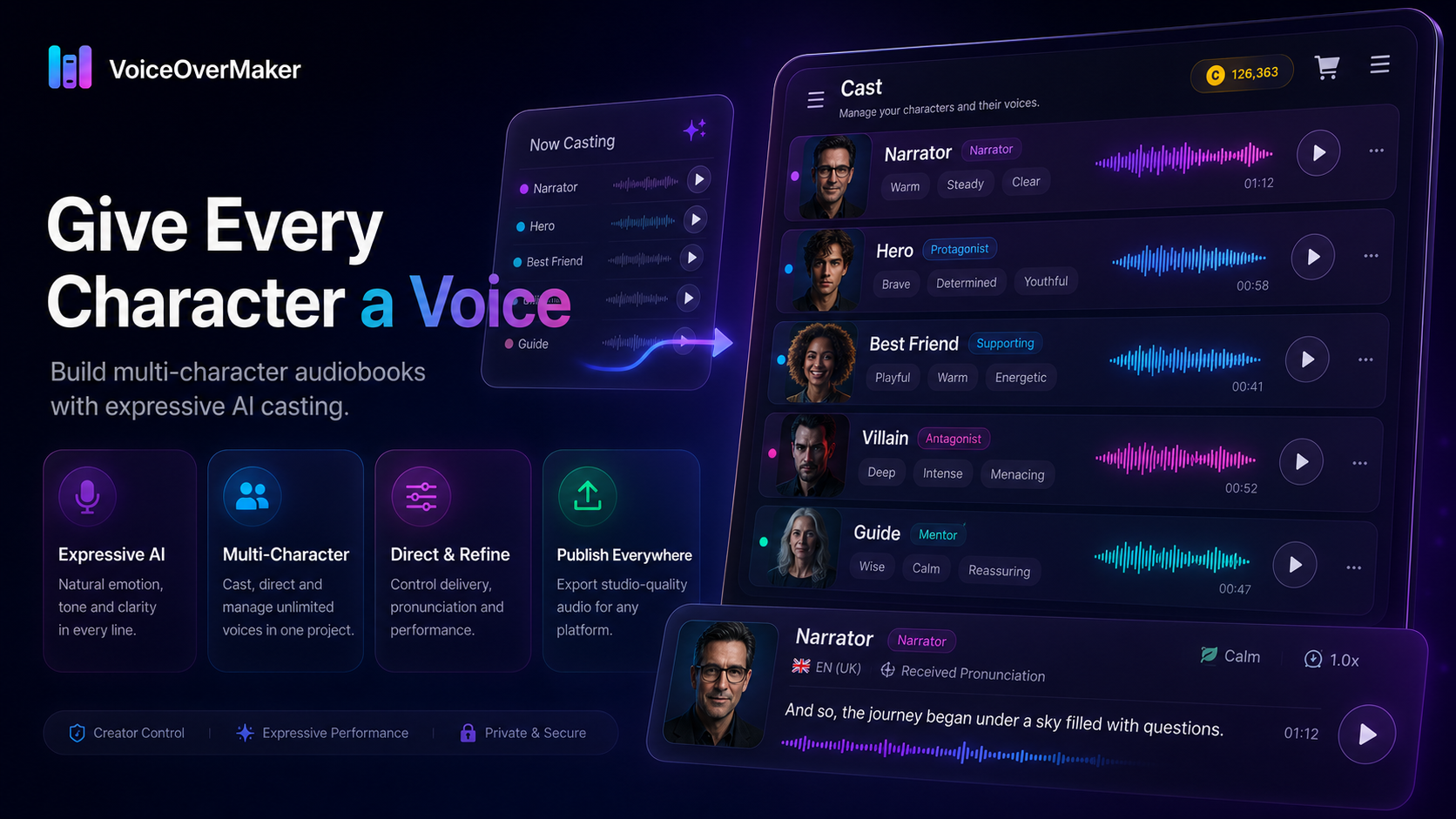
Every character has a voice on the page. The challenge is making sure the listener can hear that difference.
In a traditional single-narrator audiobook, one performer may subtly alter tone, rhythm and pitch for every character. A full-cast production goes further by assigning different performers to different roles.
AI voice workflows create a third option: build a reusable digital cast and direct the performance scene by scene.
The Three Core Jobs: Casting, Pronunciation and Delivery
A clean multi-character workflow can be organized around three questions:
- Casting — Who should speak each role?
- Pronunciation — How should names, places and unusual terms be spoken?
- Delivery — How should the performance feel in this scene?
This structure separates problems that are often mixed together. A voice can be perfectly cast but mispronounce a name. A pronunciation can be correct while the emotional delivery is wrong. Fix the right layer.
Step 1: Identify the Actual Cast
Do not start by assigning voices to every proper noun. Create a cast list with Role, Character, and Voice Direction columns:
Prioritize characters with significant dialogue. Minor characters who appear once can share a voice or use the narrator with adjusted delivery.
Step 2: Separate Narration From Dialogue
A sentence can contain more than one performer. Structure your production so the system does not have to guess the speaker. The more explicit your production structure, the easier it is to edit later.
If a paragraph mixes narration with dialogue, split it into separate blocks — one for the narrator, one for the character. This takes more time upfront but eliminates confusion throughout the production.
This is the same block-based principle that makes audiobook production manageable at scale. If you are turning an existing manuscript into audio, start by marking every speaker change as a new block.
Step 3: Audition Voices on Real Dialogue
Do not cast an actor only by listening to "Hello, welcome to our demonstration." Use actual lines from the manuscript. A voice that sounded impressive in a generic preview may suddenly feel wrong in context.
For each major character, select two or three representative lines:
- A calm, conversational line
- An emotional or high-stakes line
- A line that interacts with another character
Generate these with your candidate voice. Listen to all three before committing. The voice needs to work across the full emotional range your character will experience — not just in a neutral demo.
Step 4: Test Voices Together
Casting is relational. A strong narrator and a strong protagonist can still be a poor combination if they sound too similar. Preview short conversations. Contrast can come from:
- Tone — warm versus cool
- Pace — measured versus quick
- Energy — restrained versus animated
- Accent — subtle regional differences
- Age impression — younger brightness versus mature depth
- Vocal weight — light versus resonant
- Emotional style — expressive versus understated
If two characters who frequently share scenes are hard to tell apart, adjust one. You do not need to recast entirely — sometimes a small change in pace or energy creates enough separation.
Step 5: Create a Pronunciation Sheet
Fantasy, science fiction, historical fiction and international stories often contain names that are not obvious from spelling. Create a simple project dictionary:
Review each important term before generating dozens of chapters. Fixing a mispronunciation after producing an entire book means regenerating every block where that word appears.
Step 6: Direct Emotion Without Recasting
A common mistake is changing the voice actor when the character's mood changes. If Maya is frightened in Chapter 3, she is still Maya. Change the delivery, not her identity.
VoiceOverMaker's expressive workflows can apply direction at the performance level:
- Calm
- Excited
- Serious
- Curious
- Whisper
- Dramatic
- Slower ending
The character stays the same. The performance adapts to the scene. This is what separates a believable full-cast production from one that feels like a voice demo reel.
Step 7: Use Speech Modifiers Carefully
Modifiers are powerful when they support the story. A script may include:
- Whispering
- Laughing
- Sighing
- Speaking nervously
- Sarcasm
- Shouting
- Deep breath
- Pause
But a story overloaded with explicit effects can sound artificial. Use them as punctuation, not wallpaper. If every other line has a modifier, the listener stops noticing them — or worse, finds them distracting.
Reserve modifiers for moments that matter: a whisper before a revelation, a sigh after a loss, a laugh that breaks tension. The rest of the performance should carry itself through casting and delivery alone.
Step 8: Think in Performance Blocks
One reason VoiceOverMaker's block-style storytelling workflow is useful is editability. If Block 17 has the wrong performance, you fix Block 17. You should not have to regenerate the entire chapter.
This matters especially for audiobook creators producing at volume. When your workflow is block-based:
- A single mispronunciation costs one regeneration, not a full chapter
- Recasting a minor character means swapping only their blocks
- Adding a scene between existing blocks does not disrupt what came before
- Client feedback on a specific moment can be addressed surgically
Step 9: Check Continuity Across Chapters
The hardest audiobook errors often happen between sessions. You produce Chapter 4 on Monday and Chapter 5 on Thursday, and something drifts. Create a continuity checklist:
Before starting each new chapter, listen to the last thirty seconds of the previous one. Make sure the transition feels like a continuous production, not two separate recording sessions.
Step 10: Listen Like a Reader
Close the script. Listen. Ask yourself:
- Can you understand who is speaking?
- Does the scene flow?
- Do pauses feel natural?
- Are emotional moments earned?
- Does the cast sound like one production?
If you find yourself needing to check the script to figure out who said what, something needs adjustment — either more voice contrast, better block structure, or clearer emotional direction.
The goal is not perfection on first pass. It is a workflow that lets you identify and fix the right layer without starting over.
Who Is Multi-Character Audio For?
This approach is particularly useful for:
- Fiction authors — novels with dialogue-heavy scenes
- Children's storytellers — characters that young listeners can identify instantly
- Mystery writers — where knowing the speaker is critical to following the plot
- Fantasy creators — large casts with distinct cultures and backgrounds
- Audio drama experiments — pushing toward radio-play style production
- Educational dialogues — teacher/student or expert/interviewer formats
- Language-learning content — different speakers for different roles in conversation
- Indie publishers — full-cast production without full-cast budgets
- Interactive-story creators — branching narratives with persistent characters
Not every book needs a full cast. A quiet memoir may work best with a single voice. A technical manual does not benefit from character casting. Choose the production style based on the material.
Once your audiobook is produced, you will want to think about where to distribute and sell it to reach the right listeners.
Start Casting Your Characters
Download VoiceOverMaker free. Assign voices to each role, preview scenes, and produce a full-cast audiobook from your iPhone.